

Remove the Biggest Barrier to Electrification
Store energy when it's cheap. Use it when your fleet needs it.
Why Fleets Need Battery Storage
When electric vehicles charge, they don't do it evenly. Buses return from their routes, trucks come back at shift change, and suddenly every charger on site is running at once. Without storage, that surge hits your grid connection directly — triggering peak demand penalties, potential utility-mandated upgrades, and hard limits on how fast your vehicles can charge.
Battery storage changes the equation entirely. Instead of your grid absorbing every spike, the battery supplies the surge power when demand peaks, keeps your grid connection within its limits, and charges itself back up during off-peak hours when electricity is cheapest.
Owning and managing batteries comes with risks. What if you could offload them to someone else?
Upfront battery costs range from $300k–$1M+ per MWh.
Grid upgrades can cost $1.2M–$2.0M per site.
Most fleet operators don't have in-house energy expertise to manage the complexity.
Learn more
What Is Battery as a Service?
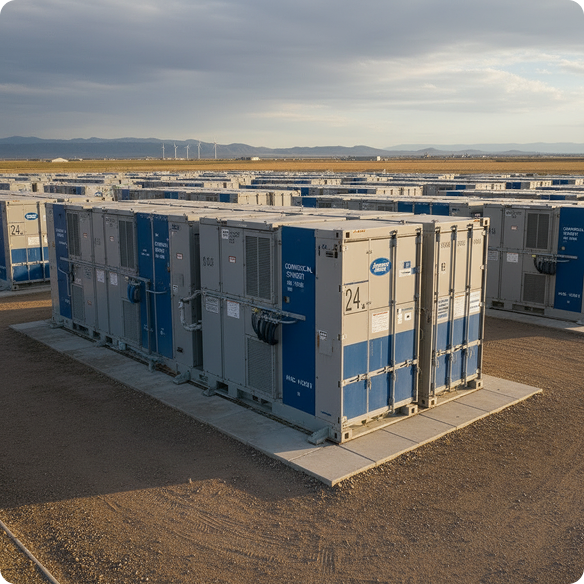
Battery as a Service is a subscription model, in which BeyondEV owns, deploys and manages the battery infrastructure on your site, and you pay a fixed monthly fee instead of buying the asset outright. You get full use of the storage without the capital outlay, the technology risk or the need for in-house energy expertise. And unlike financing models that simply move the cost, BaaS includes everything needed to make the battery actually perform. NexusCharge runs on every BaaS deployment, providing real-time energy optimisation, analytics and engineering support throughout the life of the contract. End-of-life management is included too, so you're never left holding ageing technology.
What's Included in the BaaS Subscription:
- Battery hardware (BESS), deployed on your site
- Maintenance throughout the 7-year term
- Engineering support throughout the asset lifecycle
- End-of-life management and replacement
- Energy Trading (optional)
The Three-Way Comparison Table
See how Battery as a Service stacks up against outright purchase and typical leasing arrangements.
Outright Purchase
CapEx
Internal expertise needed
EMS optimisation
Maintenance
End-of-life
Exposure to demand charges
Battery as a Service
CapEx
Internal expertise needed
EMS optimisation
Maintenance
End-of-life
Exposure to demand charges
Typical Leasing
CapEx
Internal expertise needed
EMS optimisation
Maintenance
End-of-life
Exposure to demand charges
CapEx
Internal expertise needed
EMS optimisation
Maintenance
End-of-life
Exposure to demand charges

Who BaaS Is For?
Fleet depots needing 1–5 MWh of storage, sites with significant peak demand charges, organisations without internal energy teams, and operators being held back by grid upgrade lead times.
These customers don't always know they need energy storage — they know they have big energy constraints. BaaS removes the barrier by turning a complex infrastructure project into a simple monthly subscription.
Leasing just the battery without smart control is like hiring a logistics manager who won't look at your schedule. The value of storage comes from real-time orchestration. This is what separates Beyond EV BaaS from generic hardware leasing — the EMS is embedded.
Book a scoping callWhy BaaS Only Works If the EMS Does Too
A battery on its own is just expensive backup power. The value comes from controlling when it charges and when it discharges.
NexusCharge charges the battery when energy is cheap, dispatches it when your fleet needs a surge, and when the whole system has capacity to spare, sells back to the grid when prices are high. A well-orchestrated battery stops being a cost centre and becomes a revenue opportunity.
Frequently Asked Questions
Everything you need to know about Battery as a Service. Can't find the answer you're looking for? Book a scoping call with our team.